
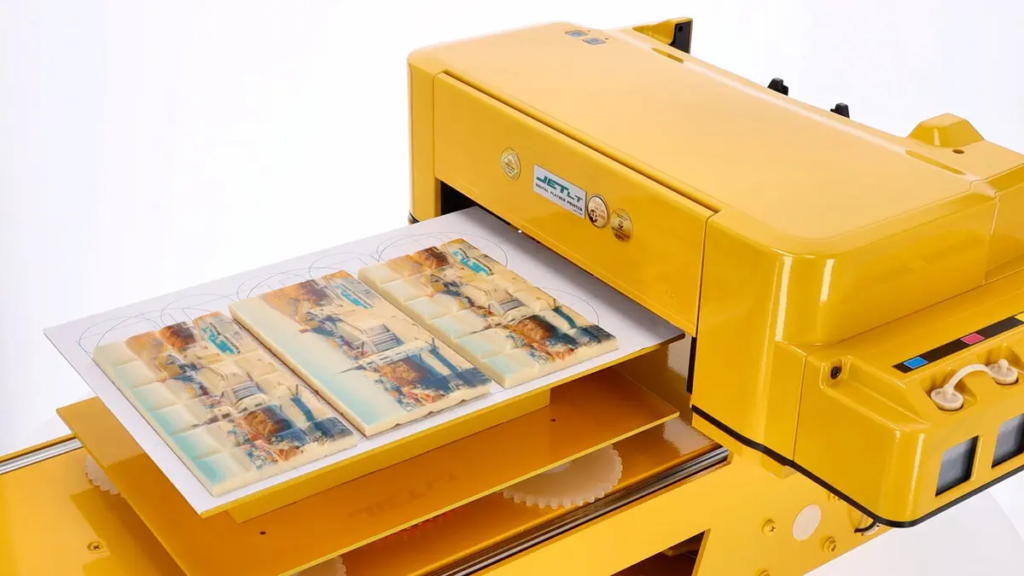
Every few weeks a curious question shows up in engineering forums: why is edible printing — printing images onto cakes, cookies, and chocolate — always done with inkjet printers and never with laser printers? The answer touches on chemistry, thermodynamics, and material science.
The laser printer problem
Laser printers work by fusing plastic toner particles onto a substrate with heat. The toner contains synthetic polymers, iron oxide pigments, and charge control agents — none of which are food-safe. Even if the pigment were replaced with an edible dye, the fusing process itself requires temperatures around 180–220°C, well above what edible substrates like sugar sheets or wafer paper can tolerate. The sheet would scorch before the image formed.
Additionally, the electrostatic mechanism that guides toner in a laser printer requires the substrate to have specific dielectric properties. Wafer paper and sugar sheets do not have consistent electrical properties across a batch, which would produce inconsistent image quality even if the thermal problem were solved.
Why inkjet works
Inkjet is fundamentally a cold, non-contact process. A print head — usually piezoelectric or thermal — ejects microscopic droplets of liquid ink onto the substrate. The droplet volume is in the picoliter range, and the substrate never exceeds room temperature.
The ink itself is the interesting part. In food-safe inkjet systems, the ink base is a mixture of purified water, glycerin as a humectant, and edible dyes approved by regulators — typically E102, E110, E122, E133 and similar. The result is a liquid that behaves almost identically to conventional printer ink from the print head’s perspective, but is fully edible.
Print head compatibility
Not every inkjet head can handle edible inks. The pigment particles in edible inks are larger than in synthetic inks, and their surfactant properties are different. Print head manufacturers have to certify their nozzles for food ink, or the nozzle geometry has to be pre-adapted. Many commercial edible printers use modified Canon or Epson piezoelectric heads with dedicated food-grade cartridges.
Machines purpose-built for continuous commercial use — the kind supplied by specialized food printer manufacturers — often include daily cleaning cycles and cartridge alignment routines that keep the head clog-free through thousands of prints.
Resolution and color
Food-safe inkjet reaches resolutions of 720 × 720 dpi in most consumer-grade models, and up to 5760 × 1440 dpi in higher-tier professional models. Color fidelity is limited by the edible pigment palette — the visible spectrum is narrower than in synthetic CMYK. In practice, most portraits and brand logos reproduce accurately; ultra-saturated fluorescent colors do not.
The takeaway
The reason food-safe printing has stayed within inkjet is not conservatism. It is that laser printing physically cannot be adapted to edible substrates without redesigning the entire process. Inkjet aligns naturally with the chemistry, thermodynamics, and safety requirements of edible printing — which is why the industry converged on it.