
A New Chapter for European Atmospheric Science
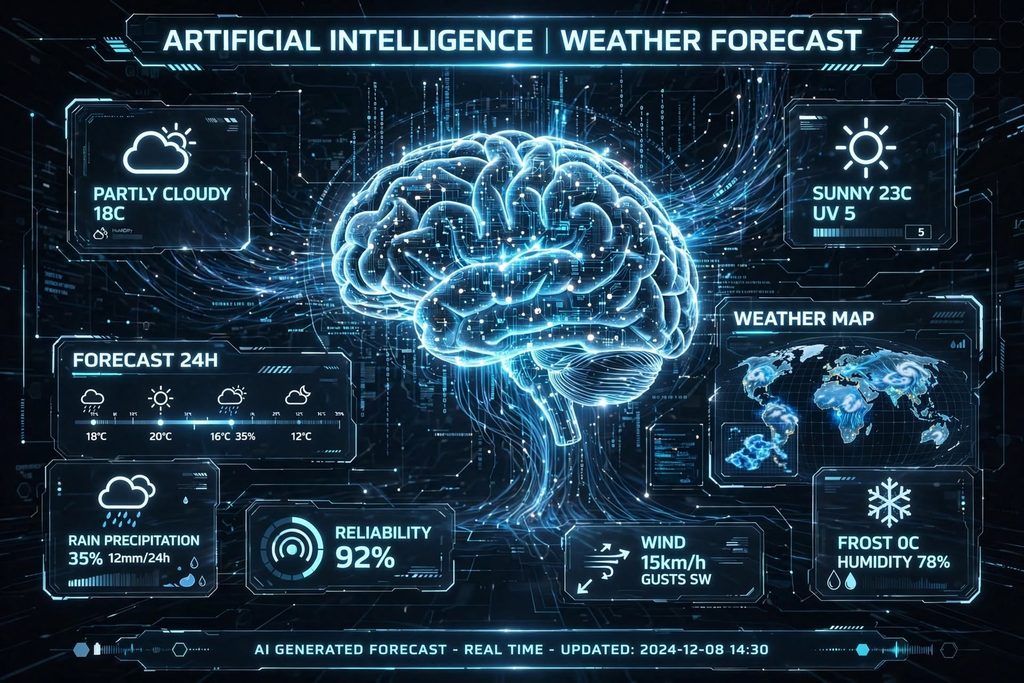
Planning a weekend getaway to the seaside, scheduling spring agricultural work, or confirming regional travel flights has traditionally relied on regular weather updates that occasionally missed sudden meteorological shifts. Across the European continent, rapid shifts in climate dynamics have made atmospheric behavior noticeably harder to predict through classical mechanics alone. To tackle this, a quiet technological transition is underway as artificial intelligence steps into operational meteorology. European forecast institutions, long anchored in rigid mathematical equations running on supercomputers, are rapidly testing and deploying machine learning models. These data-driven architectures do not merely flag approaching storm systems; they ingest and evaluate colossal global observational streams in minutes rather than hours. For daily life and commerce, this evolution delivers timely updates, clearer severe-weather alerts, and significantly improved planning reliability across every municipality.
The Capabilities and Constraints of Classical Physics
To recognize why this shift matters, it is useful to review how forecasts have been formulated for the past half-century. Numerical Weather Prediction relies on simulating fluid mechanics and atmospheric thermodynamics through partial differential equations. These equations calculate how heat, moisture, pressure, and air masses move across a three-dimensional grid wrapping the planet. While physical principles guarantee realistic continuity, calculating these formulas across millions of grid cells requires massive supercomputers running full cycles for several hours. This computational demand consumes substantial electricity and limits how frequently forecasts can be refreshed throughout the day. Furthermore, localized microclimatic phenomena – such as summer squalls developing swiftly over coastal inlets – can slip past coarse grid cells before calculations even finish.
Learning From Decades of Atmospheric Observations
Artificial intelligence adopts an entirely different computing strategy that sidesteps recalculating classical physics equations from zero every run. Instead of numerically solving Navier-Stokes equations, advanced machine learning architectures learn fundamental meteorological correlations directly from decades of reanalysis archives. Models such as GraphCast, Pangu-Weather, and the European Centre for Medium-Range Weather Forecasts’ proprietary AIFS examine historical records of atmospheric variables to spot complex patterns that remain hidden in standard numerical schemes. This approach allows neural networks to understand how specific combinations of jet streams, temperature anomalies, and barometric depressions evolve forward in time. Rather than ignoring physics, these systems encode physical laws implicitly through empirical data at remarkable inference speeds.
Institutional Innovation at the Heart of Europe
Europe has consistently driven global standards in forecasting quality, and the European Centre for Medium-Range Weather Forecasts plays a pivotal steering role in this transition. This collaborative institution, working in close coordination with national meteorological services, created the Artificial Intelligence Forecasting System (AIFS). AIFS runs side by side with the operational Integrated Forecasting System, allowing European researchers to cross-verify forecasts directly. Through shared open initiatives like the Anemoi software suite, meteorological centers across member states can collaboratively train, refine, and deploy localized models. This collective framework ensures cutting-edge tools remain accessible to public agencies rather than being locked within private technology silos, safeguarding open data transparency for European citizens and scientific researchers alike.
Dramatic Energy Savings and Rapid Computational Speeds
A major operational benefit of deep learning models lies in their unprecedented computational efficiency. Running a ten-day global ensemble forecast with conventional models routinely occupies supercomputer nodes for hours, whereas machine learning inference performs the identical task in under a minute on a single specialized graphics workstation. This shift corresponds to an energy reduction of nearly a thousandfold per single run. Such speed empowers forecasters to refresh atmospheric projections multiple times per day and evaluate dozens of subtle trajectory variations without congesting computing pipelines. Furthermore, the reduced hardware barrier allows regional universities and independent research centers to conduct advanced atmospheric studies without maintaining multimillion-euro data clusters, supporting broader European environmental and sustainability targets.
Tracking Dangerous Atmospheric Extremes in Real Time
As shifting weather patterns bring severe regional precipitation events, destructive convective gusts, and persistent seasonal heat domes, early warning speed has become critical for community safety. Neural architectures demonstrate notable proficiency in tracking the paths of rapid cyclones, intense low-pressure systems, and atmospheric moisture corridors days ahead of occurrence. Emergency response coordinators, civil defense planners, and municipal infrastructure teams can take precautionary measures with significantly longer preparation windows. Machine learning techniques excel especially in nowcasting, which combines real-time radar echoes, satellite imagery, and ground sensor data into immediate updates. When minutes dictate whether flash flood barriers are deployed successfully, these systems provide valuable operational lead time.
Regional Nuances Across Baltic Landscapes
Local geography presents complex atmospheric dynamics, characterized by alternating humid maritime fronts moving off the Baltic Sea and dry continental high-pressure zones arriving from the eastern plains. During winter months, these interactions frequently cause hazardous black ice, freezing drizzle, or sudden coastal thaws, while summer brings localized convective downpours that drench one district while leaving adjacent fields completely dry. Machine learning models are increasingly trained on high-resolution local datasets to reflect these regional interactions accurately. While global grids often smooth out small geographical features, tailored neural networks learn how water temperatures, coastal breezes, and forest canopies affect wind currents and cloud formation, equipping regional meteorologists with clearer local insights.
Systematic Comparison: Numerical Methods Versus Neural Networks
Evaluating classical numerical weather prediction against modern machine learning highlights why the industry is moving toward hybrid architectures that leverage the unique advantages of both methodologies.
| Evaluation Metric | Classical Numerical Prediction (NWP) | Machine Learning Forecasts (AI/ML) |
| Computation Duration | Requires dozens of minutes to several hours | Generates full global outlooks in seconds |
| Hardware Overhead | Demands extensive high-performance clusters | Operates on compact GPU workstations |
| Physical Consistency | Strictly governed by thermodynamics equations | Learned statistically from training data |
| Novel Extreme Outliers | Handles unprecedented physical deviations reliably | Tends to smooth out unseen anomalies |
| Input Dependencies | Needs instantaneous atmospheric conditions | Requires decades of cleaned historical archives |
This comparative landscape underlines why combining physical validation with machine learning speed provides the most dependable forecast outcomes across regional sectors.
Concrete Value for Green Energy and Precision Agriculture
Advanced meteorological modeling translates into tangible economic stability for regional agricultural operations and growing renewable energy grids. With rapid investments in solar photovoltaic parks and onshore wind turbines, matching grid loads with variable power production is vital to avoid supply volatility. Deep learning models forecast cloud cover dynamics, surface radiation, and wind shear variations at specific turbine altitudes with high precision. Concurrently, farming enterprises utilize accurate soil moisture calculations and frost risk warnings to optimize sowing windows, plan protective actions, and schedule harvesting operations efficiently. Minimizing resource waste through localized data helps farmers preserve capital while simultaneously lowering environmental footprints across rural communities.
The Enduring Need for Professional Human Expertise
The rapid ascent of machine learning often sparks discussions about whether human meteorologists will become obsolete. Operational reality demonstrates that human analytical judgment remains indispensable. Neural networks function through statistical inference, which means they can occasionally misinterpret unprecedented meteorological situations that have no historical match in their training archives. Qualified meteorologists understand local terrain features, interpret model discrepancies, and apply critical oversight before broadcasting severe weather notices to the public. Experienced forecasters know how coastal lagoons, inland river valleys, and elevated ridges alter airflows in ways that generalized algorithms can overlook. Human expertise acts as the vital safety checkpoint ensuring automated data translates into reliable guidance.
Did You Know That…
Historical milestones and computational metrics illustrate how dramatically atmospheric science has evolved over the past decades.
- The earliest automated numerical forecast was completed in 1950 on the ENIAC computer, requiring a continuous 24-hour run simply to calculate a 24-hour prediction.
- Contemporary neural network architectures such as GraphCast can complete a full global ten-day atmospheric trajectory in under sixty seconds.
- European earth observation platforms and ground radars collect millions of observation points daily, allowing neural networks to digest data streams that classical systems had to filter down.
- The Baltic Sea is among the shallowest brackish water bodies on Earth, creating atmospheric interactions that make coastal forecasting particularly complex.
- Transitioning routine inference workloads to machine learning models cuts supercomputing electricity consumption by up to one thousand times compared to traditional physics pipelines.
Collaborative Innovation Between Tech Pioneers and Public Agencies
A notable characteristic of the current technological wave is the productive dynamic between commercial technology developers and public meteorological institutions. Research teams at Google DeepMind, Huawei, and Nvidia developed pioneering architectures like GraphCast, Pangu-Weather, and FourCastNet, which proved that deep neural networks could match or exceed standard numerical benchmarks. Rather than competing destructively, these technical breakthroughs encouraged European meteorological services to accelerate their own internal digital modernization programs. The resulting environment fosters open-source development, unified algorithmic standards, and active academic exchanges. This shared innovation model ensures that cutting-edge software engineering directly serves public safety, municipal planning, and climate adaptation strategies.
Making Practical Sense of Consumer Weather Applications
For everyday consumers, this technology is already visible through updated interfaces on smartphones, consumer tablets, and local informational portals. Many popular applications now incorporate data streams generated by machine learning models, allowing daily outlooks to refresh substantially faster throughout the day. Nevertheless, consumers should avoid relying solely on a single automated forecast widget when arranging sensitive outdoor operations or commercial travel. National meteorological portals continue to provide the most dependable benchmarks, as their published forecasts synthesize multi-model ensembles validated by regional analysts. Recognizing that precipitation probability percentages reflect areal likelihood rather than storm intensity helps readers interpret digital notifications with greater practical accuracy.
Addressing Interpretability, Transparency, and Data Constraints
Despite notable performance achievements, data-driven forecasting raises technical challenges that European researchers are actively addressing. The most prominent dilemma involves the “black box” nature of complex deep neural networks, where algorithms generate highly accurate predictions while leaving the exact internal reasoning opaque. In operational meteorology, where municipal protective decisions and aviation safety depend on clear physical parameters, system interpretability remains paramount. Additionally, if historical training archives contain measurement gaps or instrument calibration errors, networks can inadvertently propagate subtle biases. European atmospheric scientists are dedicating considerable resources to explainable AI and physics-informed models, ensuring predictive systems maintain transparency alongside raw mathematical precision.
The Horizon: Personalized and Hyperlocal Environmental Intelligence
Over the coming decade, meteorological updates will become increasingly personalized, fine-tuned, and seamlessly integrated into smart infrastructure. Emerging models are progressing toward micro-level forecasting that accurately resolves climate conditions for individual city districts, agricultural zones, and municipal transport corridors. Next-generation geostationary satellites, including the newest Meteosat series, capture high-frequency imagery of cloud systems, while neural networks translate these dense signals into actionable operational forecasts. For European communities, this means greater certainty when navigating unexpected weather changes and protecting communal assets against seasonal volatility. While controlling natural elements remains impossible, understanding their movements through advanced intelligence is becoming one of modern science’s greatest collective achievements.